
Movie Serials of the 1930s, 1940s and 1950s

The movie serial was a popular cliffhanger film format shown at cinemas from the 1930s to the 1950s. Let’s find out what the serials experience was like from a space adventure fan and expert.
Originally published in the early 2000s under the title The Beloved Serials!, here Roaring Rockets explains how the format worked as popular entertainment. RR also runs through a list of some of the best movie serials and greatest heroes.
Original article by Roaring Rockets:
Movie serials from the 1930s and 1940s were a godsend to local TV stations in the period 1949-55. The 20 minute serial chapters were perfect for an every-weekday 30 minute late afternoon time slot, with a cartoon or two added. The result was that, for example, just after or just before a 15-minute TOM CORBETT SPACE CADET broadcast from the network, kids could watch a thrilling serial episode, with the “to-be-continued” ending guaranteed to induce the kids to tune in tomorrow, same time, same station.
What follows is a purely personal, purely subjective list of the serials shown on TV in those days that left the deepest impression on two kids in the early 1950s.
THE PHANTOM EMPIRE (1935)
This 12-chapter Mascot serial offered singing cowboy Gene Autry his first starring role, in what has to be one of the most sublimely, surpassingly surrealistic serials ever made. Consider the following– 5 or 6 miles underground below the dude ranch owned by Gene is the long-lost superscientific civilization of Murania.
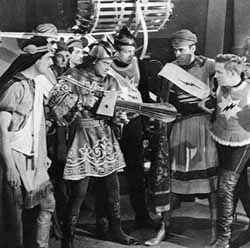 Gene has not one but two juvenile sidekicks (Frankie Darrow and Betsy King Ross). Further, Gene has not one but two comical sidekicks (Smiley Burnett and Bill Moore). Gene will lose the ranch unless he shows up every day to do a live radio broadcast of western songs — so simply being locked in a closet by his enemies (and he has many, both above and below ground-level) will result in an agonizingly suspenseful chapter ending. But there are many exciting chapter endings, including the forever classic situation in which Gene, Betsy and Frankie are left literally hanging from a cliff by their fingertips!
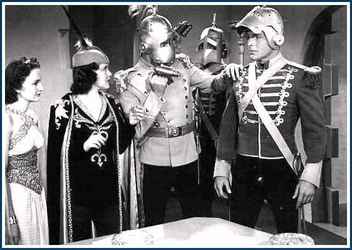
The serial’s real focus is on the city of Murania, represented by a surprisingly detailed miniature, and by some great, huge-looking futuristic sets. You can count on the fingers of one hand all the super-scientific future cities we ever got a glimpse of in the early 1950s, either on film or TV, and Murania is at the top of the list. As presided over by the regal Queen Tika (icy blonde Dorothy Christy, who also portrays Stan Laurel’s terrifying wife in SONS OF THE DESERT), Murania is a hotbed of cardboard robots, scheming noblemen, mad scientists, and labs full of giant levers, spinning dynamos, gigantic pistons, spheres emitting large sparks, bubbling chemical retorts, flickering gauges, giant rayguns, huge TV screens, welding torches that emit 6-foot flames, and other high-tech wonders. Almost every detail of Murania is surpassingly strange. One aspect that delighted me and my brother when we saw it in the early 1950s is that whenever a recently-dead corpse is returned to life, by the marvellous medical technology of Murania, he speaks incomprehensible words — “The language of the dead,” as the chief scientist helpfully explains! [Also: doctors in Murania wear black instead of white surgical outfits!]

In the leading role, Gene Autry is extremely likeable and unassuming. The audience cares deeply what happens to him, despite the often absurd goings-on that surround him. For him, it was the auspicious beginning of a long, richly successful movie, radio, TV and recording career. Note too the very subtle chemistry between Gene’s character, and Queen Tika. In Gene’s later singing westerns, he would win over even the most feisty females just by singing them a little song; probably the serial’s only lapse is that he never gets to sing for the Queen!
THE CRIMSON GHOST (1946)
This 12 chapter Republic serial is mainly remembered today for its wonderful villain, the Crimson Ghost, who for no good reason wears scarlet robes (we assume; the serial, of course, 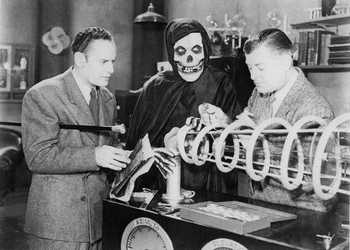 is in black and white), a grotesque skull mask, and skeleton-fingered gloves. Speaking with the distinctive voice of I. Stanford Jolley, portrayed physically by an anonymous stuntman, and commanding a huge gang of henchmen, including future Lone Ranger Clayton Moore, The nefarious Ghost is after a superscientific invention, a ray gun called the Cyclotrode, with the help of which he hopes to commit a series of outrageous crimes. As in almost all Republic serials, the running time is taken up with nicely choreographed fist fights, and a variety of vehicle chases. It’s all fairly bland and mundane, especially when compared to THE PHANTOM EMPIRE, but full of continuous action and excitement nonetheless. Like many serial villains, the Ghost has a device that turns captives into willing slaves. The hero, played by Charles Quigley, doesn’t make much of an impression, but his female counterpart is the smolderingly lovely Linda Stirling… a great plus to any serial in which she appears. We kids liked it all; the incessant Republic fist fights were still new to us at this time. The fact that the plot never goes anywhere at all (a problem that only got worse with the Republic serials made after this one) didn’t bother us.
THE FIGHTING DEVIL DOGS (1938)
Another 12-chapter Republic serial, this one remains famous today for its villain, the Lightning. 
Viewed today, this is a dreadfully claustrophobic production; to cut costs, the decision was made to film most “outdoor” action in the studio on a cramped stage in front of a small rear-projection screen. But in the context of 1950s live space adventure TV, also confined to tiny indoor sets, it fit right in.
FLASH GORDON (1936), FLASH GORDON’S TRIP TO MARS (1938), BUCK ROGERS (1939) and FLASH GORDON CONQUERS THE UNIVERSE (1940)
These are among the best known and best loved serials today, and they were a mainstay of local TV in the science-fiction-happy early 1950s. In fact, at least two of them were run fairly continually from about 1950 well into the 1960s, in un-edited form. [All serials shown on TV in the 1970s, we are told, were generally cruelly cut down to 2-hour continuous features; if these are all you ever saw, you never saw a real serial.]
After you see one, especially at the age of 10 – 12, Buster Crabbe will be forever your hero and ideal. Energetic and athletic, he could convincingly fend off three monsters at once, and he was a good enough actor to make the viewer take the often absurd goings-on with proper seriousness and interest.

The serial’s adventures take place in a wide variety of settings, to include a flying city, a city on the ocean bottom, and underground caverns haunted by monsters. No one will ever forget the stubby silvery spaceships, spitting 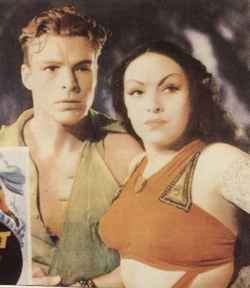 puffs of smoke and dropping sparks, while emitting a sound like a small motorboat. There are even some very wobbly flying saucers, piloted by the Lion Men, among which Thun is a leader.
Virtually alone among serials, FLASH GORDON has sexual tension. Princess Aura comes close to orgasm whenever she gets a good look at Flash’s chiselled profile and rippling muscles, while every Mongo warlord from Ming on down is busy formulating plans to go for Dale’s abundant groceries. Ming, of course, comes closest to getting the goodies, actually marrying Dale in the eyes of the Great God Tao (don’t ask!), before Flash stages a typically last-second rescue.
FLASH GORDON’S TRIP TO MARS (15 chapters, Universal) doesn’t hold up nearly as well. Flash has an annoying comical sidekick, “Happy” Hapgood (Donald Kerr), a forerunner of Lyn “Happy” Osborn; Jean Rogers as Dale is now a brunette, and worst of all is attired in nearly every scene in caftan-like costumes that cover up her lovely physique almost completely, from neck to toes; Ming has to time-share with the colorless Azura, Witch Queen of Magic (Beatrice Roberts); and, the smoldering Princess Aura is nowhere in sight, although Barin turns up in pursuit of Ming. We do have a nice alien race, the Clay People, victims of Azura’s evil magic. There’s not a lot of high-tech on view in the serial. Azura’s city is not all that Martian, in fact, being represented [if dim memory serves] by inconsistent clips of various cities seen in the first serial, although it does have neato “light bridges” between buildings, some strange art-deco interior doors, and the irrepressible Ming is attacking earth with a large, impressive ray-gun, the oddly-named “Nitron Lamp.” The serial is marred greatly by tacked-on, agitated music that is never at all appropriate to the action it accompanies.

Some interest perks when Buck and his pals have to go to Saturn, to form an alliance with the oriental-looking Saturnians, led by Prince Tallen (Philson Ahn), while fighting off the Clay-People-like Zuggs. One neat feature of the underground Saturnian civilization is a pneumatic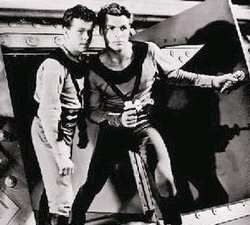 subway with cars that are transparent cylinders. Like too many serial villains, Killer Kane has a convenient mind-control device to turn Buck and his allies into helpless zombies.
The strange space ships shown in the serial look nothing like the designs featured in the syndicated BUCK ROGERS comic strips of the day. They are vaguely like giant flatirons, but they do spit the smokepuffs and sparks, and emit the motorboating sound, that Universal science fiction serial lovers had come to expect.
FLASH GORDON CONQUERS THE UNIVERSE (12 chapters, Universal) is the last and by far the least of the Buster Crabbe serials. In fact, it is almost unwatchably dull. The cast is no help. Carol Hughes is a slender, graceful, tights-clad but totally unsexy Dale, Roland Drew makes no impression as Barin, and Shirley Deane makes Aura a shrill-voiced and (in some shots) painfully ugly princess. The clay people of TRIP TO MARS are retreaded as Mongo Rock Men, and there are some laughable robots, called “annihilatons.” Ming is given a lovely blonde companion in evil, Lady Sonja, but is so weighed down by the ridiculously elaborate costumes he and all the other characters wear that even he doesn’t come up to snuff. A sad commentary on the action, sets and settings is that about the only interesting footage seen in the serial consists of short clips borrowed from a German mountaineering film, WHITE HELL OF PITZ PALU, directed by the legendary Leni Riefenstahl. Apart from these clips there is virtually no action, unless you consider Flash and Barin perpetually creeping about the corridors of Ming’s palace to be action. The serial was a box-office flop in 1940, and greatly disappointing to kids in the 1950s.
A very subjective impression is that the two serials most often shown on TV in the 1950s were BUCK ROGERS and CONQUERS THE UNIVERSE. The first FLASH GORDON was not seen nearly as often, and TRIP TO MARS was very seldom shown.
 I can’t now recall whether I never saw it as a kid, or saw it only once, as a few isolated chapters… I think the latter. But in any case, it’s impossible for me to think of TOM CORBETT or CAPTAIN VIDEO without thinking of good old Gene Autry in Murania, Flash among the Hawk Men and Shark Men, or the Crimson Ghost plotting his latest bank robbery. I saw them all together, at that most impressionable age of all.
And Jan Merlin says, “I recall playing Flash Gordon with the other kids on the block after seeing the chapters on Saturdays… my little friend, Oliver Wong, was Ming the Merciless for obvious reasons, his younger sister was Ming’s daughter… and we had a blond playmate to play Flash’s girl… One day, I accidentally broke Oliver’s arm… and when my mother and I went to the local shirt laundry to pick up something she’d had washed there, the oriental man loomed over the counter to glare at me and said, ‘YOU KNOW OLIVEE?’ I nodded fearfully, and he warned, ‘No more make believe!’ He would have said I had grown up and turned out as expected….”
